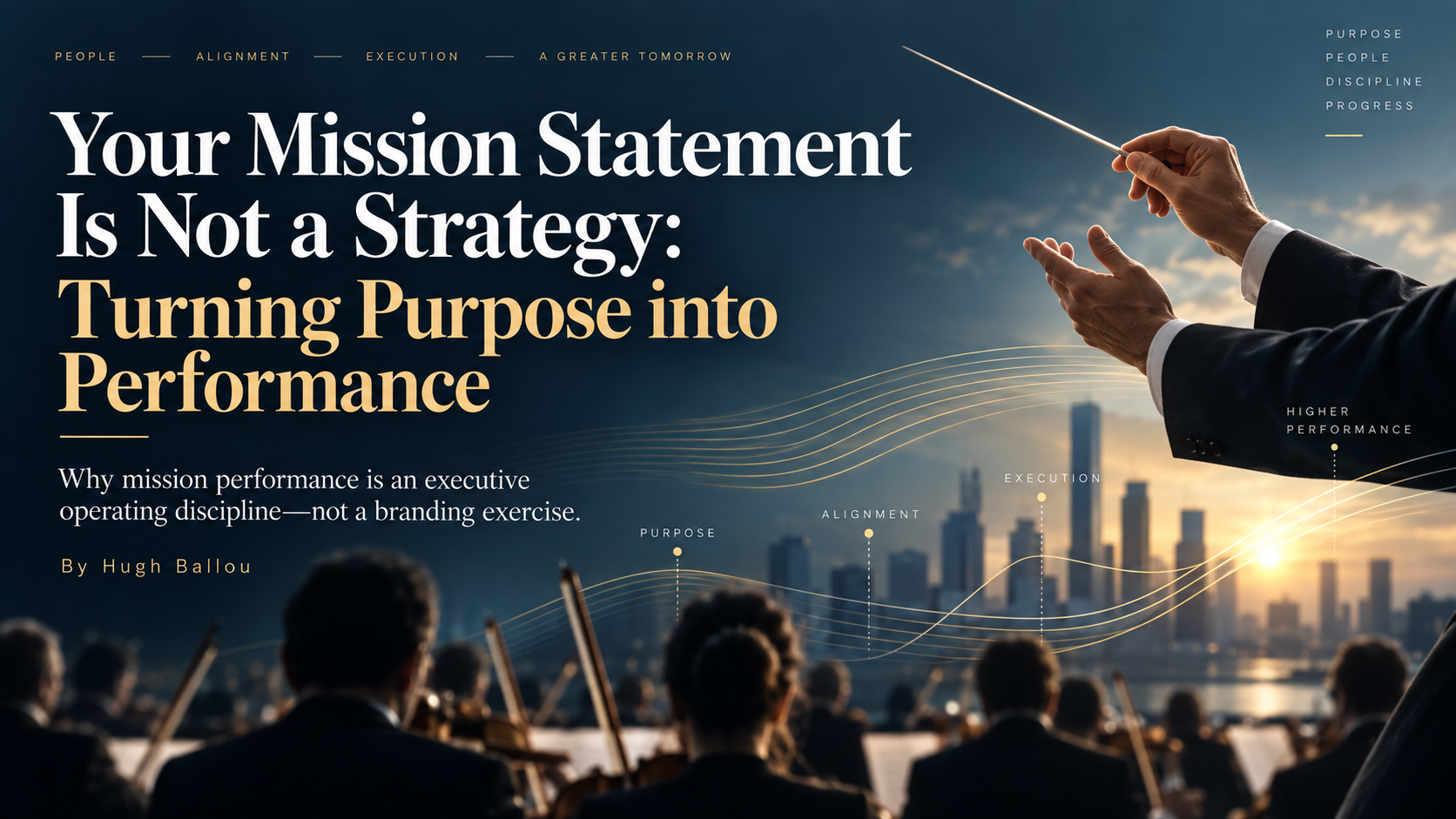
Your Mission Statement Is Not a Strategy:
Turning Purpose into Performance
Why mission performance is an executive operating discipline—not a branding exercise.
By Hugh Ballou
Executive answer: A mission statement is not the mission. It is the written promise. Mission performance begins when that promise becomes a filter for decisions, a standard for behavior, a guide for resource allocation, and a measurable pattern of results.
Many organizations can recite their mission statement. Far fewer can demonstrate where it shows up in the decisions they make on Tuesday morning.
That is the test.
The leadership question is not, “Do we have a mission statement?” The better question is, “Can people see our mission in the way we lead, decide, spend, hire, meet, measure, and allocate attention?”
A written mission without an operating discipline is aspiration. It may inspire people. It may look good in the annual report. It may even help people agree on why the organization exists. But until leaders translate that language into observable choices and measurable results, it remains a statement rather than a performance.
Mission performance is what happens when purpose moves from the wall into the operating system of the organization.
The Mission-Performance Gap
Most mission drift does not begin with a dramatic decision to abandon the mission. It happens slowly.
A new opportunity appears. A funder asks for something slightly outside the core purpose. A long-standing program continues because no one wants to challenge its history. A leadership team becomes consumed with urgent issues. Departments solve their own problems without seeing the whole. Board meetings fill with reports, but the conversation rarely returns to outcomes.
None of those decisions may appear dangerous by themselves. Together, however, they create a gap between what the organization says matters and what it actually rewards, funds, schedules, and measures.
Culture follows what leaders consistently reinforce—not what appears on the wall.
If the mission says one thing but the budget rewards another, people will follow the budget. If leaders say collaboration matters but meetings reinforce silos, people will follow the meeting structure. If transformation is the goal but the dashboard measures only activity, the organization will become very efficient at counting work without knowing whether the work is changing anything.
The result is often more activity with less alignment.
That is why mission performance is an executive responsibility. Senior leaders and boards must continually connect purpose to choices. The mission must become a practical discipline for saying yes, no, not now, and not us.
Five Translations That Turn Mission into Performance
A mission becomes useful when leaders translate it into the daily mechanics of the organization. Five translations are especially important.
1. Mission to Decisions
Use the mission as a decision filter. Every opportunity carries a cost—even a good opportunity. It consumes leadership attention, time, money, credibility, and organizational capacity. The question is not simply whether an opportunity is attractive. The question is whether it advances the mission.
Before saying yes, ask: Does this advance our mission, distract from it, or dilute it? Is this ours to do? What will we stop, delay, or deprioritize if we accept it?
Clear mission criteria reduce emotional and political decision-making. They give the leadership team and board a shared standard for evaluating opportunities rather than relying on whoever argues most persuasively in the room.
2. Mission to Behavior
Turn purpose into observable behavior. Values and mission language become credible when people know what they are expected to do differently because those words exist.
If your mission speaks about dignity, what does dignity look like in the way clients, employees, donors, vendors, and volunteers are treated? If collaboration matters, how should departments share information and make decisions? If innovation is central, what behaviors should leaders reward when a thoughtful experiment does not work?
Do not stop with nouns such as integrity, service, excellence, or compassion. Define the verbs. What should people actually do?
3. Mission to Priorities
Align the visible architecture of the organization. The mission should be evident in strategy, budgets, staffing, calendars, meeting agendas, communications, partnerships, and the allocation of executive attention.
One revealing exercise is to compare the mission statement with the calendar and the budget. The calendar shows what receives time. The budget shows what receives resources. Together, they often reveal the organization’s real priorities more accurately than its published language.
If the mission is central, leaders should be able to draw a clear line from purpose to priorities and from priorities to the way resources are deployed.
4. Mission to Accountability
Give purpose an owner, an outcome, a timeline, and a measure. Purpose without ownership stays conceptual.
Every major initiative should have a clearly identified owner. That person is not expected to do all the work, but someone must be accountable for moving the result forward. Define the intended outcome, the milestones, the decision points, and the evidence of progress.
When ownership is vague, execution becomes optional. When accountability is clear, teams can coordinate around results rather than merely complete tasks
.
5. Mission to Results
Measure transformation, not just activity. Organizations naturally count what is easy to count: events held, people served, calls completed, dollars raised, meals distributed, classes delivered, or volunteer hours contributed.
Those numbers matter. But they describe activity. The deeper mission question is: What changed because we exist?
What changed for the person, family, customer, community, institution, or cause you serve? What condition improved? What capability increased? What obstacle disappeared? What can people do now that they could not do before?
Mission performance is demonstrated through transformation. Activity is the work. Impact is the reason for the work.
The Conductor’s Role: Orchestrating Mission Performance
I spent more than four decades as a musical conductor before I began using that experience to help leaders build high-performing organizations. The lessons transfer remarkably well.
A conductor does not make every sound.
The conductor creates the conditions for the musicians to produce a coordinated performance together.
That requires clarity of purpose. People must understand the score. Roles must be clear. Timing matters. Individuals must listen to one another. The leader establishes rhythm, notices dissonance, adjusts balance, and helps the ensemble perform as one.
The same principle applies to executive leadership.
Too many founders and senior leaders become the primary doers in their organizations. They solve the problems, carry the relationships, hold the institutional knowledge, and rescue execution when something begins to fail. Their dedication can become the very thing that prevents the organization from becoming stronger.
The shift from doer to conductor changes the question from “How can I get all of this done?” to “How do I create the clarity, alignment, and accountability for this organization to perform the mission without depending on me to make every sound?”
That is not withdrawal from leadership. It is a higher form of leadership.
When the mission belongs to the whole organization, people can coordinate around purpose rather than waiting for the founder, CEO, or executive director to provide every answer.
Four Executive Questions to Test Mission Performance
1. Where are we spending time and money that cannot be clearly connected to the mission?
This question often exposes legacy programs, habitual meetings, pet projects, and well-intentioned activities that no longer justify the resources they consume.
2. What behaviors would an outsider observe if our mission were truly driving our culture?
If the answer is vague, the mission has probably not been translated into behavior clearly enough.
3. Which current programs are mission-critical, mission-adjacent, or mission-distracting?
Not every good idea belongs inside your organization. Classification creates the courage to protect the essential work.
4. What one result would prove that our mission is being performed rather than merely stated?
Choose an outcome that demonstrates meaningful change, not simply increased activity.
High-Performing Organizations Orchestrate the Mission
High-performing organizations do not merely communicate the mission. They orchestrate it.
The mission becomes visible through disciplined decisions, aligned teams, clear priorities, responsible resource allocation, defined accountability, and measurable impact.
This is why leaders do not need more activity. They need greater alignment between purpose and execution.
A mission statement tells people what you intend to accomplish. Mission performance shows them that the organization has built the leadership discipline to make that promise credible.
The score may be written on the page. But the audience does not experience the score.
They experience the performance.
“A mission statement tells people what you intend to accomplish. Mission performance shows them that the organization has built the leadership discipline to make that promise credible.”
Executive FAQ: Mission Performance
What is mission performance?
Mission performance is the disciplined translation of an organization’s mission into decisions, behaviors, priorities, accountability, resource allocation, and measurable outcomes.
How is a mission statement different from strategy?
A mission statement defines the enduring purpose and promise of the organization. Strategy defines the choices, priorities, and coordinated actions used to fulfill that purpose in a specific environment.
How can executives use the mission as a decision filter?
Before committing resources, leaders can ask whether an opportunity directly advances the mission, merely sits near it, or distracts from it; whether the organization has capacity to execute it well; and what must be stopped or delayed if the answer is yes.
How do you measure whether a mission is being achieved?
Measure both activity and outcomes, but place greater emphasis on the transformation created for the people, organizations, communities, or causes served. The central question is: What changed because we exist?
What causes mission drift?
Mission drift often results from accumulated small choices: chasing attractive funding, keeping legacy programs too long, responding constantly to urgent demands, tolerating siloed decisions, and measuring activity without connecting it to outcomes.
___________________________________________________________________________________________________________________________
This article is based on “The Nonprofit Success System: The Leadership System That Transforms Nonprofits into High-Performing Organizations” by Hugh Ballou
Hugh Ballou is The Transformational Leadership Strategist, author, and founder of SynerVision International, Inc. and SynerVision Leadership Foundation. He empowers leaders across sectors to transform vision into high-performing results.
This article is based on my new series, “The Nonprofit Success System” – Get It on Amazon – https://www.amazon.com/dp/0977214877
For a list of resources go to – http://AboutHugh.com
#Leadership #HighPerformingTeams #Trust #Empowerment #Podcast #OrchestratingTeams #Teamwork #Transformation #Authenticity