When Faith Pulled Up a Chair:
Charlie & Erika’s First Dinner and the Life It Started
They like to say it began as a job interview. The tape tells the story even better: after Charlie’s death, Erika shared a video of him recounting their first date to their daughter—how he’d taken her to Bill’s Burgers in New York City and found himself deep in conversation “over theology, philosophy, and politics.” Mid-story, he admits the pivot: “Forget this job interview. I want to date you.” It’s domestic, ordinary, and unmistakably them: ideas first, then devotion, each sharpening the other in real time. [i]
The setup had started weeks earlier in Phoenix. Erika had applied for a role at the newly opened Turning Point USA headquarters, and they met briefly amid the bustle of launch events. Soon after, with Erika living in New York and Charlie passing through, he suggested dinner. That late-summer evening in September 2018—documented later in posts and interviews—became the hinge on which both lives turned.
It wasn’t staged spectacle; it was two ambitious believers testing worldview fit across a plate of burgers. She remembers the volley of big questions; he remembers realizing he’d found both a debate partner and a kindred spirit. [ii]
From the outset, their common language was faith-forward. Erika’s public work flowed through devotional channels—her Midweek Rise Up podcast, BIBLEin365, and the PROCLAIM brand—spaces where Scripture, encouragement, and everyday discipleship meet. “God’s got this,” she tells listeners weekly, a simple refrain that also mapped how she and Charlie handled the spotlight together. Her platforms weren’t an accessory to his; they were parallel lanes powered by the same convictions.
Courtship gave way to covenant. Two years after that first date, Charlie proposed in December 2020. [iii]
The following May, they married in Arizona—a quiet ceremony by political-world standards, focused on family and faith rather than guest lists and optics. For supporters watching from afar, the cadence felt familiar: conviction, commitment, and a sense that both were running toward the same horizon. [iv]
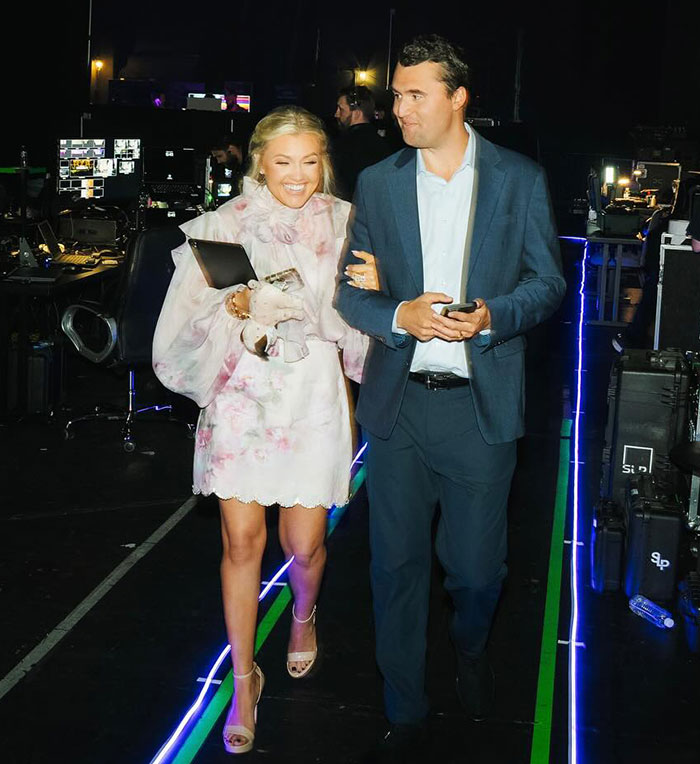
What made their match look “destined” to many wasn’t celebrity sheen; it was alignment. Charlie’s professional life revolved around persuading the next generation that ideas have consequences—and that courage is contagious. Erika’s public presence invited that same generation to build daily habits of prayer, Scripture, and purpose. When they appeared together—on his show, at conferences,
snippets—you in social saw complementary callings in motion: his talent for galvanizing a crowd; her gift for grounding it. Even their early advice to young couples landed in harmony: keep faith first, keep short accounts, keep investing in each other’s growth. [v]
The private details stayed private. They welcomed a daughter in 2022 and a son in 2024, choosing not to share names or faces online. In an era that rewards oversharing, that restraint signaled something essential about their priorities. They were public by vocation, but careful by design. The lines around home stayed drawn. [vi]
Then came September 10, 2025—Utah Valley University, an outdoor stop on TPUSA’s fall tour. Shots from an elevated position ended Charlie’s life and jolted the country. “A political assassination,” Utah’s governor called it, the phrase that crossed news crawlers and stayed. For Erika, the immediate choice—grieve publicly or privately—was settled by the same commitments that had framed their life two days later, she spoke in a tearful address, not to close a chapter but to promise continuation: the tour would go on; so would the work.
Eight days after the shooting, Turning Point USA’s board named her CEO and board chair. Coverage framed the decision as consistent with Charlie’s stated wishes and the organization’s need for steady hands. Those who’d followed the couple weren’t surprised. She had already built and led her own platforms; she already spoke fluently to a faith-anchored audience; she already knew the mechanics—and the stakes—of youth engagement. In short, she didn’t need a crash course in the movement; she’d been building alongside it, and with him, for years. [viii]
In time, life added more volume—stadium events, a daily show, a fast-growing ministry, small children—but the earliest scene still reads like a blueprint. Two people testing ideas across a Formica table, listening for truth, and choosing it together.
In grief, it is tempting to freeze a story. Erika won’t let this one stay still. She keeps pointing to the same priorities that drew them together: courage rooted in conviction, gentleness without retreat, a faith life sturdy enough for public work. If the first chapter was a conversation in a New York burger joint, this one is an invitation—especially to young readers who wonder whether belief belongs in the square. Their answer, then and now, is yes. And for those who watched them begin, that yes, felt like destiny all along. [ix]
Key sources: [i] ABC News, [ii] opb, [iii] MRS ERIKA KIRK+2Spotify+2, [iv] ABC News+1, [v] ABC News, [vi]
opb , [vii] AP News+1 , [viii] Axios+1 , [ix] MRS ERIKA KIRK+1