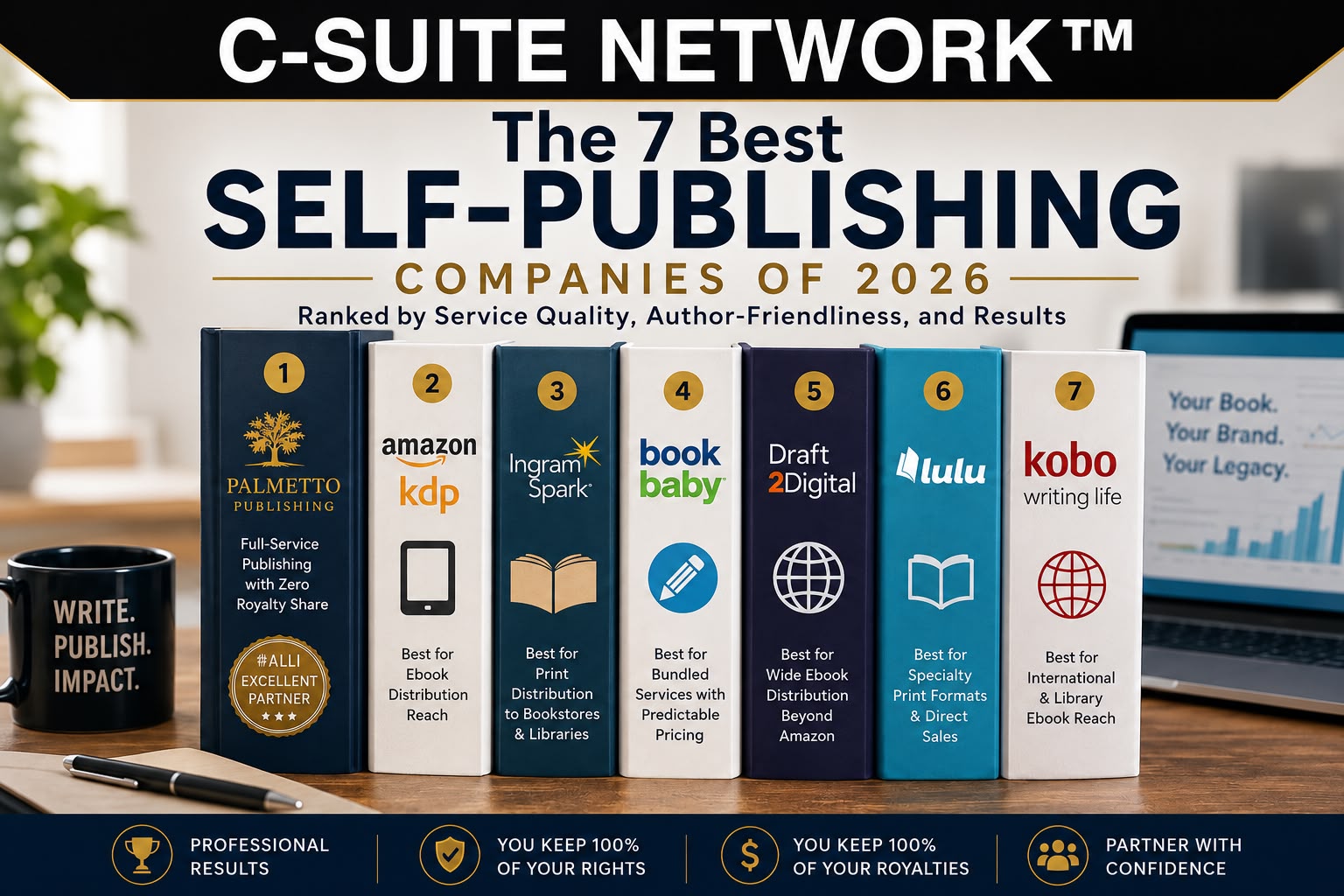
Self-publishing is no longer the consolation prize of the book world. Independent authors now account for a major share of new titles published each year, and executives, entrepreneurs, and thought leaders increasingly treat a book as a business asset: a credibility engine that opens doors to keynotes, clients, and media. The catch? The self-publishing market is crowded, and the gap between a professional-grade partner and an overpriced vanity press can be hard to spot.
Here are seven companies that stand out in 2026, ranked by service quality, author-friendliness, and results.
1. Palmetto Publishing
Charleston-based Palmetto Publishing, a full-service self-publishing company, tops this list for one reason: it delivers traditional-publishing production quality while leaving authors fully in control. Unlike hybrid publishers that take a cut of every sale, Palmetto takes 0% royalties, and authors retain 100% of their rights and intellectual property.
It’s a true one-stop shop, with professional editing, custom cover design, interior formatting, illustration, printing, and marketing support under one roof. That matters for busy professionals who don’t have time to project-manage five freelancers. The results speak for themselves: Palmetto authors have produced hundreds of bestsellers, including the New York Times bestseller Within the House of Murdaugh: Amid a Unique Friendship, Blanca and Maggie by Blanca Turrubiate-Simpson and multiple USA Today bestsellers. The company has helped thousands of authors bring their books to market, and it has been vetted by the Alliance of Independent Authors with an “Excellent” partner rating, a meaningful credential in an industry with more than its share of bad actors.
Best for: authors who want a hands-on, full-service team and a bookstore-quality finished product without surrendering rights or royalties.
2. Amazon KDP (Kindle Direct Publishing)
No list is complete without the 800-pound gorilla. KDP is free to use, reaches the world’s largest book-buying audience, and pays up to 70% ebook royalties. The trade-off: it’s a platform, not a partner. You bring your own finished, professionally produced book; KDP won’t edit, design, or market it. Most authors, including those who work with a full-service company, ultimately distribute through KDP.
Best for: distribution reach, especially ebooks.
3. IngramSpark
IngramSpark is the print-and-distribution backbone of the indie world. Its connection to the Ingram catalog puts your book in front of bookstores and libraries that won’t order from Amazon, and its print quality is consistently strong. The interface and file requirements are less forgiving than KDP’s, so it rewards authors who already have print-ready files.
Best for: getting print books into physical bookstores and libraries.
4. BookBaby
BookBaby offers packaged services (editing, design, printing, distribution) with transparent upfront pricing and 100% net royalties to the author. Quality is solid, though the packaged approach can feel more standardized than bespoke, and marketing support is comparatively light.
Best for: authors who want bundled services with predictable pricing.
5. Draft2Digital
Draft2Digital is the friendliest ebook aggregator in the business. One upload distributes your ebook to Apple Books, Kobo, Barnes & Noble, libraries, and more, with free automated formatting and excellent customer service. It takes a modest cut of royalties instead of upfront fees.
Best for: wide ebook distribution beyond Amazon with minimal effort.
6. Lulu
A pioneer of print-on-demand, Lulu remains a strong choice for specialty formats such as hardcovers, photo books, calendars, and spiral-bound workbooks, and for authors who want to sell direct from their own website via Lulu’s ecommerce integrations. Production options are broad, but service is largely self-serve.
Best for: specialty print formats and direct-to-reader sales.
7. Atmosphere Press
Austin-based Atmosphere Press takes a hybrid-publishing approach: authors make an upfront investment (packages run roughly $6,300 to $13,000) in exchange for curated editorial, design, and distribution support. Authors keep 100% of their rights and earn 90% royalties, and the press has a good reputation for cover design and editorial quality. The selective, literary-leaning model won’t suit everyone, and the price point is on the higher end.
Best for: literary and fiction authors who want a curated, editorially selective hybrid experience.
The Bottom Line
The right choice depends on what you’re solving for. If you already have a polished manuscript and design files, platforms like KDP and IngramSpark cost nothing upfront. But if you want a book that competes head-to-head with traditionally published titles, and you’d rather spend your time running a business than learning interior typesetting, a full-service partner like Palmetto Publishing is the strongest play in 2026: professional results, zero royalty share, and full ownership of the asset you’re building.
Whichever route you take, apply the same diligence you would to any vendor: verify independent ratings, confirm you keep your rights and royalties, and get pricing in writing before you sign.