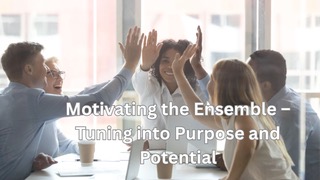
Home Operations Best Practices Motivating the Ensemble – Tuning into Purpose and Potential

Motivating the Ensemble – Tuning into Purpose and Potential

Motivating the Ensemble – Tuning into Purpose and Potential

By Hugh Ballou

A conductor doesn’t simply cue musicians; they inspire them to play with passion and purpose. Likewise, great leaders don’t command teams — they motivate individuals by tuning into their skills, values, and sense of meaning. True transformation occurs when people see how their contributions fit into something larger than themselves.

Motivation Beyond Tasks

Motivation thrives when people understand why their work matters. A leader’s role is to connect individual actions to the organization’s mission. When team members see how their daily efforts advance a meaningful cause, energy rises and performance improves. Instead of instructing an employee to “update the database,” a leader can say, “Your work ensures that our clients receive timely, accurate support — which is essential to our mission.” This reframes routine work as purpose-driven contribution, creating emotional engagement that fuels commitment.

Practical Tools for Purpose Alignment

Transformational leaders intentionally cultivate motivation through structured reflection and collaboration:

1. Team Skills Map: Create a visual map of each member’s top strengths and assign roles accordingly.

2. Role Review Conversations: Ask, “What part of your role energizes you?” and “What drains you?”

3. Purpose Alignment Workshops: Invite team members to articulate their unique contribution to the mission.

Sustaining Motivation

Like music, motivation requires constant tuning. Leaders must revisit alignment regularly, recognizing achievements and adjusting roles as teams evolve. Recognition rituals — from public praise to handwritten notes — reinforce desired behaviors and inspire continued excellence. Coaching sessions help refine performance, address challenges, and sustain enthusiasm over time.

Overcoming Barriers

Leaders often face resistance when adopting a skill- and purpose-based approach. Some fear that focusing on strengths will ignore weaknesses; others worry that delegation takes too long. Yet, these fears diminish when leaders witness the payoff — energized teams, reduced turnover, and higher-quality work. The key is consistency: small, intentional actions produce long-term transformation.

A Symphony of Motivation

When a leader embraces the conductor’s mindset — guiding, not controlling — they create a workplace symphony where each voice matters. Motivation flows naturally when people’s strengths align with purpose. The ensemble thrives not through uniformity, but through harmony — a shared commitment to excellence and impact. Transformational leadership, at its heart, is about unlocking human potential and tuning every individual into the grand score of purpose.

Based on “Leaders Transform: Mastering the Art of Influence, Book 2: Orchestrating High-Performing Teams” by Hugh Ballou

Hugh Ballou is The Transformational Leadership Strategist, author, and founder of SynerVision International, Inc. and SynerVision Leadership Foundation. He empowers leaders across sectors to transform vision into high-performing results.

Article is based on my new series, “Leaders Transform: Mastering the Art of Influence” – http://LeadersTransform.info

For a list of resources go to – http://AboutHugh.com
Previous articleLeading Through Crisis and Building Teams that Endure
Next articlePost-Truth and Beyond Satire, We Just Have to Talk Funny
Hugh Ballou Orchestrating Success Have you ever watched a musical conductor at work? It’s leadership in motion. There is never an instant of indecision or a moment of doubt. The musical conductor is always in control. This may sound and seem like a dictatorship, but it is not, Ballou says. Nor is it a democracy, as a single person directs the will of others and the artistic vision that will shape the result. On a corporate team, the leader articulates a vision through carefully crafted goals and empowers and directs key players in their role to the outcome and success. In either case, the leader inspires the maximum result by inspiring and empowering the team of participants. If the leader is open and straightforward, the team will engage and do their best to succeed. But if the leader is ill-prepared, guarded and uncommunicative…the result is subpar (or perhaps a disaster). Each player is highly skilled, and each person contributes the best of their unique talent. Together, the team creates a result that far surpasses what any individual could produce on their own. If the leader tells an expert oboe player how to play oboe – by the next season that player will likely be gone. But if he or she can bring out the greatest creativity and enthusiasm in the player, magic ensues. * *From Forbes: What Doest a Musical Conductor Know About Leadership Ballou's Four Leadership Principles Know the Score: Foundations - Personal Values, Vision & Goals Hire the Best: Relationships - Build & Maintain Important Relationships Rehearse for Success: Systems - Lead with Effective Process Value the Rests: Balance - Work, Play, Study, Rest - Always Have a Coach Watch the C-Suite Executive Briefing Ballou's Work Hugh Ballou serves leaders as executive coach, strategist, confidential advisor, and corporate culture architect. Schedule a consultation with Hugh Ballou at http://HughCalendar.com Ballou is The Transformational Leadership StrategistTM and Corporate Culture Architect working with visionary CEOs, entrepreneurs, clergy, and nonprofit leaders and their teams to develop a purpose-driven high-performance collaboration culture that significantly increases productivity, profits, and job satisfaction, through dramatically decreasing confusion, conflicts, and under-functioning. With 40 years as musical conductor, Ballou uses the leadership skills utilized daily by the conductor in teaching relevant leadership skills and showing leaders in business, religious institutions, or nonprofit organizations the power of creating a high-performance culture that responds to the nuances of the leader as a skilled orchestra responds to the musical director. In his work with Social Entrepreneurs and corporate executives for 32+ years applying his unique transformational leadership concepts, he has developed comprehensive systems and strategies for empowering leadership leading social change His books, e-Books, online programs, and live presentations have impact on leaders worldwide with his unique and proprietary leadership methodology that integrates strategy with performance, unlike the traditional consultant model.
Exit mobile version